01
What it is
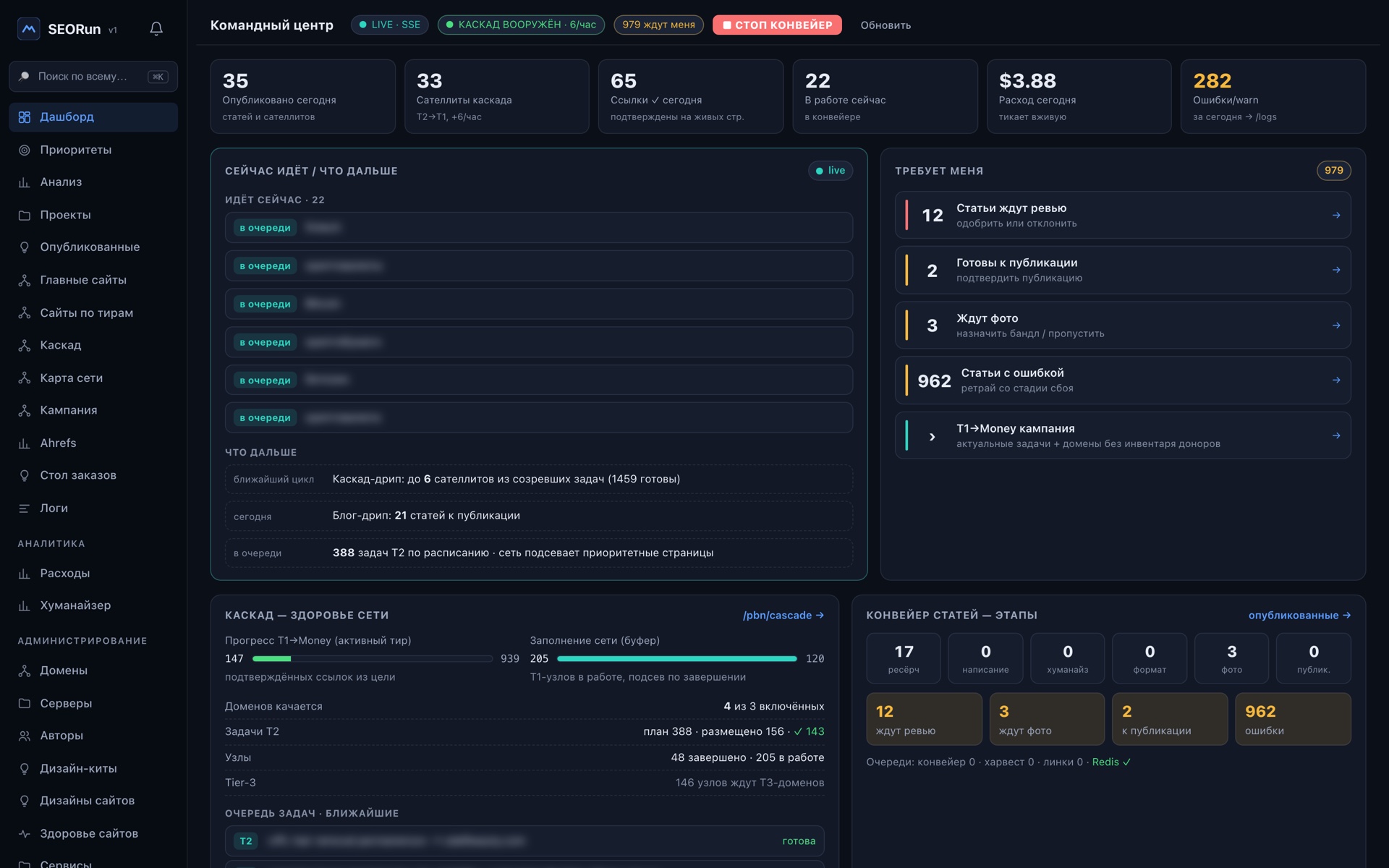
A classic SEO agency keeps its work in spreadsheets: keywords here, a content plan there, the satellite network in a third file — and the links between them live in one senior’s head. SEORun replaces all of that with a single perimeter where an article moves through seven stages automatically: keyword research, writing, humanisation, formatting with meta tags, illustration sourcing, publication and — most importantly — automatic anchor-link placement.
The other half of the system is infrastructural.
It knows all 730 network domains, checks each one weekly against two dozen criteria, builds a map of the real links between tiers, and can stand up a new site from nothing: a Cloudflare zone, NS change at the registrar, a server picked from the pool, WordPress installed over SSH, a design applied — and the domain goes live.
02
capabilities
What it does
01
A seven-stage article pipeline
SERP and volume research → persona-driven writing → humanisation with a “no 100% AI verdicts” gate → formatting with meta tags for both SEO plugin families → illustrations → publication → auto-link.
02
PBN network map
A crawler walks the sites and builds a graph of real links: T3 → T2 → T1 → Money. A wrong direction is flagged as a violation instead of hiding in a spreadsheet.
03
Health of 730 domains
A weekly checkup across 24 probes: availability, indexation, sitemap, robots, WP REST, plus SerpAPI verification with quota rotation and cached verdicts.
04
Site launches in two clicks
Registrar domain → Cloudflare zone → NS → server from the pool → WordPress over SSH → design. The queue self-heals: orphaned jobs return to work after a restart.
05
Per-key cost accounting
Every API call is recorded with its model and price. We found and fixed a silent defect that had 781 calls booked as free.
06
Autonomous loop
Daily insights at 06:00, a Monday digest, a strategist pass, topic discovery and an hourly content drip that pushes the calendar into the pipeline by itself.
03
architecture
How it works
01
Keywords and SERP research
02
Generation and humanisation
03
Publication to WordPress
04
Auto-link and tier cascade
05
GSC / GA4 analytics
Under the hood
- Fastify API plus a BullMQ worker on Node 22; PostgreSQL and Redis namespaced so neighbours on the host stay untouched.
- A single service registry in code: a new stage is described in the registry before it is implemented. Otherwise it does not merge.
- Service keys are AES-GCM encrypted and can be per-project; key selection lives in exactly one function.
- Numbered migrations applied on deploy, one transaction per file, behind a test gate — if it fails, production is never touched.
- An action log with rollback: creates, deletes and updates can be rewound.
- An egress proxy with a domain allowlist for agent-side calls.
04
scale
Numbers
730
domains under watch
24
probes per site checkup
7
article pipeline stages
5
pipelines in the service registry